


Roadheaders available in our offer
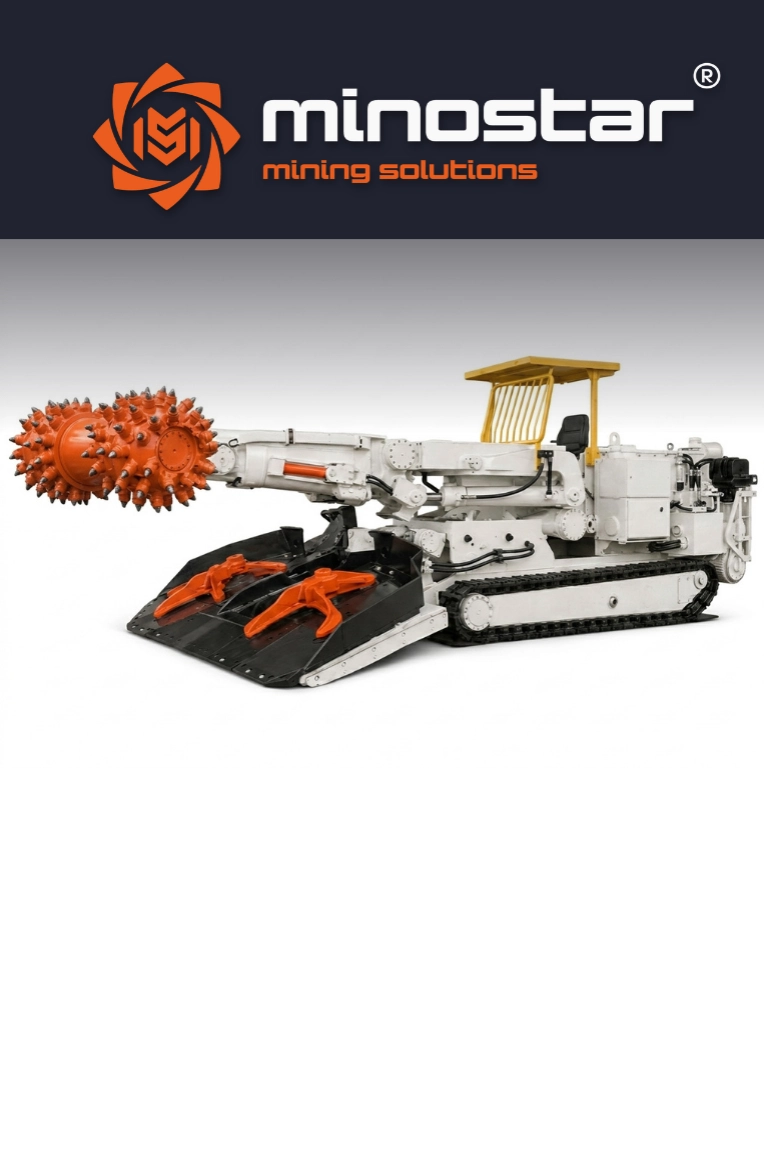
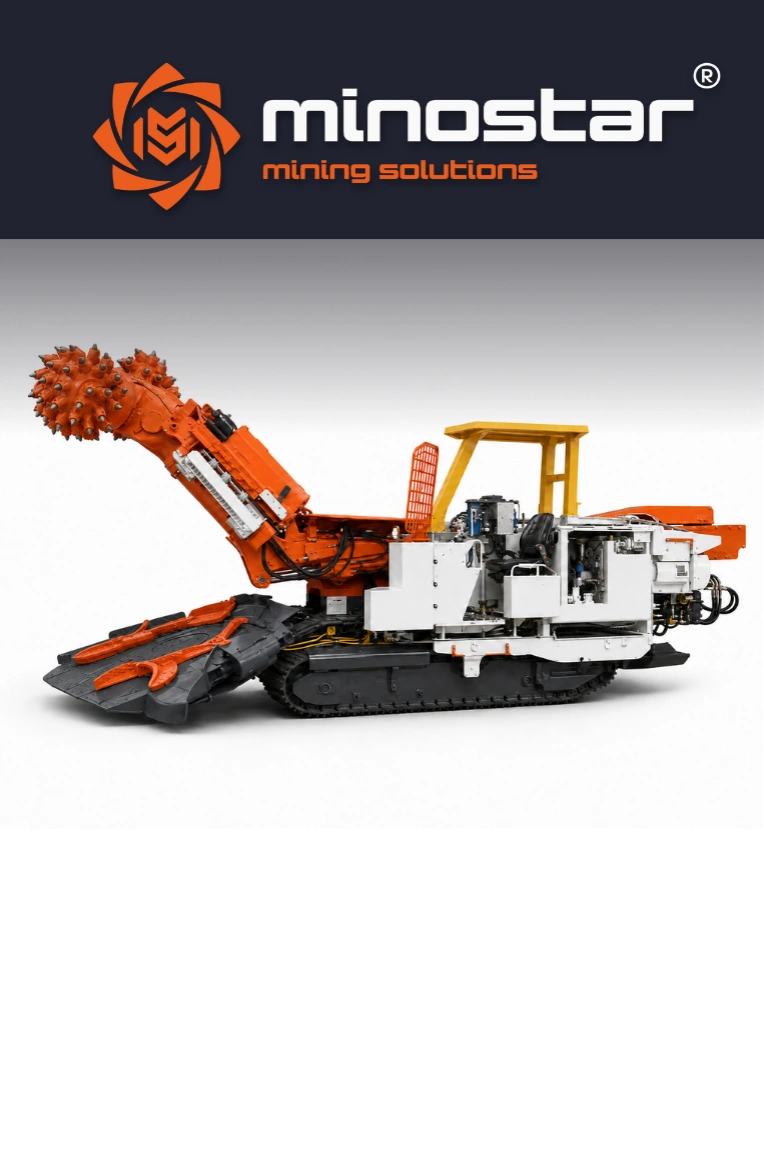
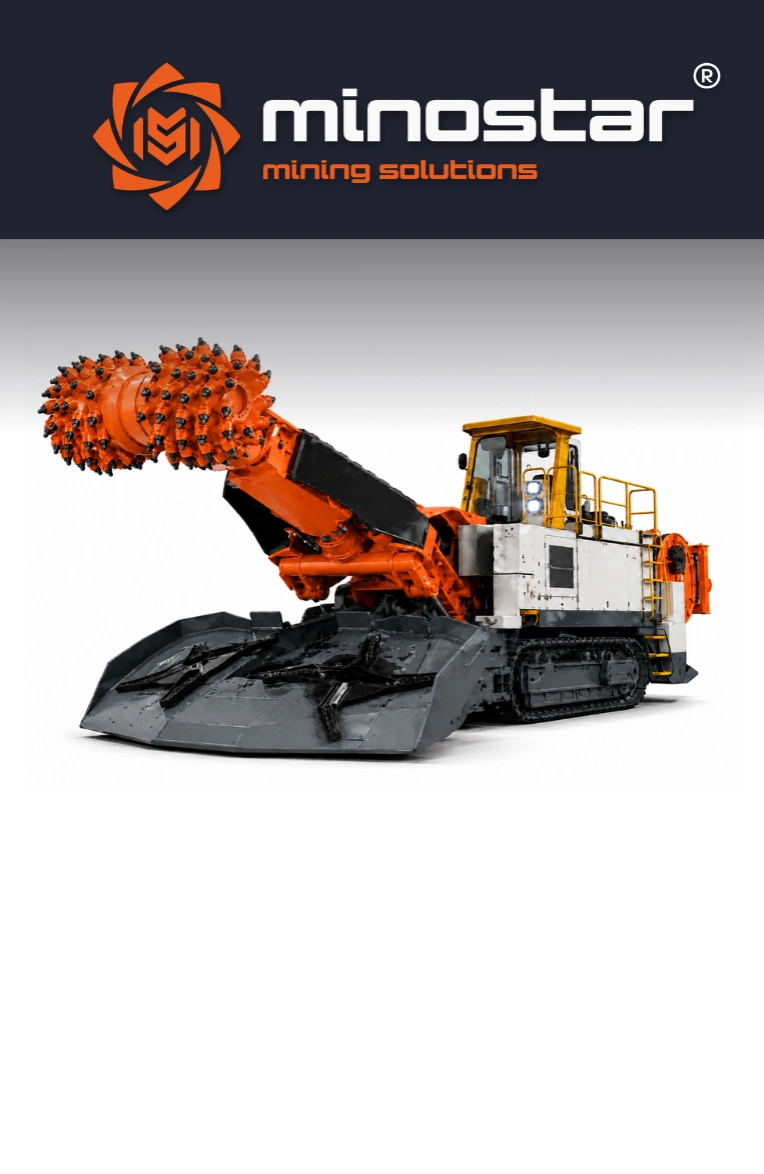
Roadheaders are specialised mining machines used for driving dog headings in coal mining, as well as in gypsum, rock, potash, salt and metal mines and in tunnel construction. They facilitate efficient extraction of mineral deposits and the development of underground infrastructure.
Minostar is your experienced partner in the repair, overhaul, revamping and sale of roadheaders and tunnel construction machines. Our range includes both new and used machines, meeting the highest quality and safety standards after professional overhaul or modernisation.
View our current offer


New and used roadheaders
We supply roadheaders from leading global manufacturers, tailored to a wide range of geological conditions and specific operational requirements. Our portfolio includes machines with diverse technical specifications – from lightweight units designed for operation in soft rock to heavy-duty equipment capable of excavating hard rock formations.
Each machine offered by Minostar undergoes thorough technical inspection, and used roadheaders are subject to comprehensive overhauls using high-quality components manufactured according to our specifications.
At Minostar, we prioritize customer satisfaction, which is why we deliver custom-engineered, proprietary solutions that often exceed the performance and functionality of original components.
We provide full technical support, expert guidance in selecting the right machine, and professional warranty and post-warranty service.
Descriptions and technical data of the most popular machines
Feel free to check out our compendium of information about roadheaders.




Roadheaders – everything you need to know
What is a roadheader?
A roadheader is an advanced mining machine used for the mechanical excavation of underground headings, including tunnels and roadways, in mining operations as well as underground construction projects. The machine is equipped with cutting heads that break and disintegrate the rock, followed by haulage systems (such as conveyors) that transport the excavated material further – either to the surface or deeper into the mine.
Roadheaders enable fast, precise, and safe development of underground workings with a defined cross-section, tailored to the technical requirements of a mine or a specific engineering project.
These machines are used across a wide range of geological conditions – from coal seams and potash deposits to harder rock formations encountered in tunneling applications. A roadheader is engineered to deliver high operational efficiency while meeting strict safety standards required in the mining industry. Each machine can be individually configured to match deposit conditions, technological requirements, or the specific nature of the project.
At Minostar, we specialize in such customization, modernization, and overhaul of roadheaders as part of our proprietary Minostar RESTART program.
How a roadheader works
A roadheader operates based on mechanical rock excavation using a rotating cutting head equipped with picks. The cutting head is mounted on a boom, which allows precise positioning at the working face and enables shaping of the excavation profile in accordance with the project requirements.
During operation, the cutting head rotates and gradually breaks the rock, which then falls onto the loading table. From there, the material is collected by gathering arms and transferred onto a chain conveyor, which carries it further for transport – for example to mine conveyors or shuttle cars.
Roadheaders are typically powered by electric drive systems supplied with 1000 V DC via trailing cables connected to the mine’s power network. This type of power supply ensures stable operation and high efficiency in underground conditions. In addition to the main electrical drives, the machines are equipped with hydraulic systems responsible for boom movement, stabilization, and auxiliary functions.
Modern roadheaders can be equipped with operator support systems such as performance monitoring, diagnostics, and elements of process automation.
Want to learn more about how roadheaders work? Click the button below and explore our article explaining the construction and operating principles of roadheaders in detail.

Applications of roadheaders
Basic applications and geological conditions
Roadheaders are widely used wherever precise and controlled excavation of underground workings is required. Their primary area of application is underground mining, where they are used for cutting various types of minerals, as well as for driving transport, ventilation and development roadways.
Roadheaders perform best in low- to medium-strength rocks, such as hard coal, salt, shales or sandstones. Their cutting efficiency is closely linked to the geomechanical properties of the mineral deposit, especially its uniaxial compressive strength (UCS). Under typical conditions, these machines operate efficiently in rocks with a strength of up to approximately 80–100 MPa, although they can also be used in harder formations – at the cost of reduced productivity and increased wear of cutting tools.
Applications in construction and operating flexibility
Outside mining, these machines are commonly used in tunnelling and infrastructure construction. They are used, among other applications, for driving road tunnels, railway tunnels, metro tunnels and underground passages. They are particularly well suited to projects where a specific excavation profile must be maintained and where the use of TBM machines is either not recommended or not economically justified.
Roadheaders can operate in workings with varying gradients. In most cases, standard machine configurations allow operation within a range of approximately -15° to +15°, depending on local conditions and the machine configuration. Operation at steeper gradients is possible, but requires proper preparation and affects both machine stability and the efficiency of excavated material transport.
Roadheaders are also used in projects related to the energy sector and heavy industry, such as the construction of underground technological installations, storage facilities and critical infrastructure structures.
The machine configuration is most often adapted to the specific geological and technological conditions present at the worksite, usually an underground mine. Based on over 12 years of experience in roadheader overhauls, modernisations and repairs, such adaptation includes, among other things, the selection of appropriate operating parameters and cutting head configuration according to the characteristics of the deposit and the Client’s requirements.
Geological limitations and tool wear
Despite their many advantages, roadheaders also have certain limitations that must be taken into account when planning excavation work. One of the key factors is the compressive strength of the rock – in very hard rock formations, cutting efficiency drops significantly, which may affect both the work schedule and operating costs.
Tool wear is another important challenge. Tangential picks operating in demanding conditions are subject to intensive abrasion, which requires regular replacement and affects the continuity of machine operation. This means that constant technical supervision and proper service support are essential – and this is also one of the areas we specialise in.
Factors affecting performance and work organisation
Roadheader performance is also influenced by the selection of the appropriate cutting head type. For this purpose, different head configurations are used, including axial and transverse cutting heads, selected according to geological conditions and the nature of the work being carried out. The correct choice of cutting head has a direct impact on cutting efficiency, tool wear and the ability to achieve the required excavation cross-section.
The limitations also include high requirements for excavated material haulage organisation and work logistics at the face. A roadheader is part of a larger underground technological system, which means that cutting efficiency depends not only on the machine itself, but also on the performance of the entire haulage system and the cooperating equipment.
The final work result is also influenced by a range of operational factors, such as machine power, cutting head design, rock abrasiveness and the degree of rock fracturing. Achieving high efficiency requires not only a properly selected roadheader, but also a well-planned technological process and experienced operators.

Comprehensive support for your roadheader
The history of roadheaders is still being written, and Minostar is not standing still. We are ready to meet every challenge: from general overhauls and modernisation of your roadheader to the supply of high-quality replacement wear parts. If you need support with your roadheader, contact us today!
History of roadheaders
Roadheaders have a long and fascinating history dating back to the 19th century, closely linked to the development of mechanization in mining and tunnel construction. The origins of this technology can be traced through early attempts to mechanize excavation processes, gradually evolving from simple manual tools to advanced machines used in underground mining operations and large-scale infrastructure projects.
Early attempts at mechanical excavation
The earliest attempts at mechanical tunneling date back to 1870, during the first efforts to construct a tunnel beneath the English Channel between England and France. At that time, one of the first tunneling machines – known as the Channel machine – was deployed. It successfully excavated approximately 2.4 km of tunnel in hard limestone formations.
The machine operated on a rail-mounted chassis and was hydraulically advanced, which was considered a groundbreaking solution for its time.
Development of roadheaders and tunneling machines in the early 20th century
The first official attempt to patent a roadheader took place in 1949, when Dr. Z. Ajtay submitted a patent application in Hungary. He developed a remotely controlled mining machine designed for extracting thin seams under challenging conditions, particularly in high-moisture environments.
The 1940s and 1950s marked a period of rapid technological advancement in mechanical excavation. The first true roadheaders appeared in the early 1950s and were initially used primarily for mechanical coal extraction. By the 1960s, roadheaders were already widely applied in tunneling works and gained global recognition by the late 1970s.
Pillars of cooperation with Minostar
Discover the values that set our company apart and form the foundation of a successful partnership
Individual approach
At Minostar, we believe that every customer deserves a unique approach to address their specific expectations. We are not another corporation blindly focused on profit – we are a reliable partner who listens to your needs. We treat each assignment individually, committing ourselves fully to each project.
Comprehensive service
We offer a full range of services to the mining industry – from the supply of parts, components and complete machines, through overhauls and upgrades under the RESTART programme, to service support during operation. Our activities are always dictated by the individual needs of our customers.
Innovative solutions
Our solutions focus on increasing efficiency, improving safety, productivity and reducing environmental impact. Our original RESTART programme, which is in line with the principles of a circular economy, makes it possible to extend the life cycle of roadheaders while optimising costs.
Full technical support
Our customers can rest assured that they will receive support from us at every stage of the project. We offer technical advice, training in the use of the machinery available in our offer and top-level servicing. Our many years of experience in the industry, confirmed by numerous certificates and assessments of our ability to carry out repairs, guarantee the highest quality of our services.
History of roadheaders
Development of the most popular roadheader models
F6-A (1964)
The year 1964 is considered a milestone in mining mechanization, marked by the development of the F6-A machine at the ÖAMG plant in Zeltweg, Austria (later Voest Alpine). The machine was still relatively immature in terms of design and had several technical limitations, which were gradually improved over time.
Despite this, the first units were already in operation by 1965 in Austria, Italy, and Morocco. With a weight of 13 tonnes, the F6-A was considered a heavy machine for its time. In total, approximately 300 units were manufactured.
AM-50 – a key model
In 1971, the F6-A machine was renamed AM-50. Its design was significantly improved, and the cutting head power was substantially increased.
The Zeltweg plant produced around 800 AM 50 units. Domestic production of the AM 50 roadheader began in 1977–1978 in cooperation with Voest Alpine. This self-propelled mining machine was designed for roadway development and was originally engineered by Voest-Alpine Bergtechnik.
AM-75 – the next stage of development
AM-75 (1981–1982) – In 1981, a prototype of the AM-75 roadheader by Voest Alpine was presented at a trade fair in Düsseldorf. By 1982, the first AM 75 machines were already operating in German mines.
With numerous improvements and design upgrades, this model remains in operation in many mines across Poland and worldwide.
Further models
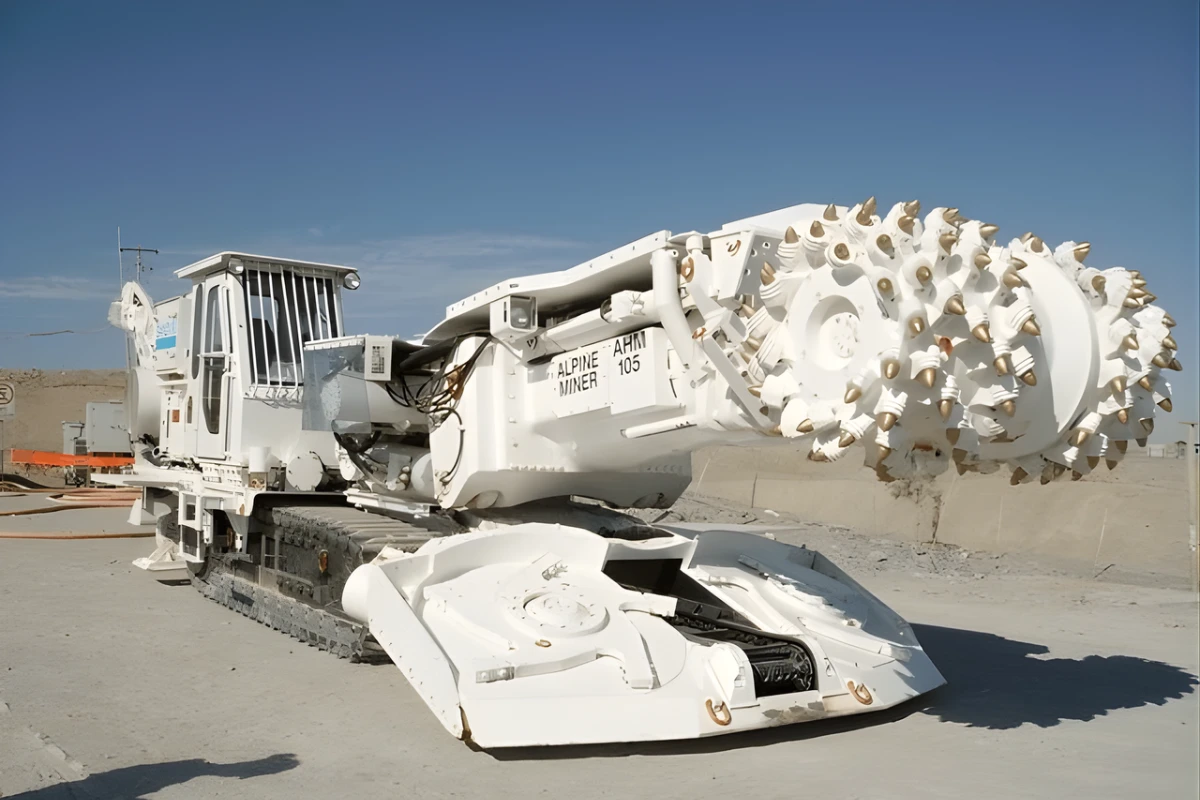
In 2002, Voest-Alpine Bergtechnik received a major order for three completely new AM 105 machines tailored for the German market. These units were scheduled for delivery in 2002 to the Prosper-Haniel, Walsum, and Warndt-Luisenthal mines.
With this order, a total of 10 AM-105 roadheaders were already operating in the German mining industry.
What else you should know about roadheaders?
What is the maximum cutting cross-section of a roadheader?
The maximum cutting cross-section of a roadheader depends on the machine model, boom geometry, and cutting head configuration. Modern roadheaders are capable of excavating a cross-section ranging from approximately 25 to 80 m² from a single machine position.
The achievable cross-section also depends on site conditions and the required excavation profile. In some cases, larger profiles can be achieved through repositioning of the machine and sequential cutting.
How much does a roadheader weigh?
The weight of a roadheader depends on its type and configuration. A commonly used machine for roadway development in relatively light geological conditions (such as the AM-50 roadheader) typically weighs between 26 and 28 tonnes.
Larger machines, such as the MR-340 roadheader, can reach a weight of around 55 tonnes. In the case of machines designed for particularly demanding conditions, the weight may be even higher, often reaching up to 100 tonnes.
What is the typical power output of a roadheader?
The installed power of a roadheader depends on its size and intended application. Lightweight machines designed for operation in soft ground conditions typically offer power in the range of 100 to 200 kW. Mid-range roadheaders are usually equipped with drives rated between 200 and 300 kW, while heavy-duty units designed for more demanding geological conditions can exceed 300 kW, in some cases reaching 400–500 kW.
The total installed power includes not only the cutting head drives, but also auxiliary systems such as hydraulics, material handling, and control systems.
Are roadheaders custom-built?
Yes, roadheaders are high-value machines, often costing millions, and are designed to match specific geological conditions and operational requirements of a given mine. Manufacturers typically build them to order, taking into account the individual needs of the client. There is also the option of purchasing a used roadheader and carrying out a professional overhaul or modernization – a service we provide as part of our roadheader refurbishment and upgrade offering.
How are roadheaders delivered to a mine?
Roadheaders are large and complex machines, yet they must ultimately reach the underground working face. For this reason, they are delivered in sections, allowing for safe transportation and subsequent assembly on site. The delivery process is adapted to local conditions and may involve both standard land transport and, where required, specialized logistical operations related to lowering and installing the machine underground.
What factors have the greatest impact on roadheader performance?
Roadheader performance is influenced by a combination of geological and technical factors. Key parameters include rock properties such as compressive strength, abrasivity, and fracture patterns. Machine power and the condition of cutting tools also play a critical role.
Operational efficiency is further affected by face organization, including the performance of the haulage system, transport logistics, and operator experience. Even a high-performance machine requires a well-designed and properly managed excavation process to achieve optimal results.
What types of cutting heads are used in roadheaders?
Different types of cutting heads are used in roadheaders depending on geological conditions and the nature of the excavation work. The most common configurations include axial and transverse cutting heads, which differ in rotation orientation and cutting mechanics.
The selection of a suitable cutting head has a direct impact on cutting efficiency, tool wear, and the ability to achieve the desired excavation profile. In practice, this choice is made during machine design or modernization, based on the specific characteristics of the deposit.
At Minostar, we tailor the cutting head configuration to the specific application requirements defined by the Client, ensuring optimal performance and long-term operational reliability.
Is it possible to overhaul or modernize a roadheader?
Yes, our company provides comprehensive overhaul, modernization, and rebuilding services for roadheaders. We particularly recommend our proprietary Minostar RESTART program, which is one of the most comprehensive solutions available on the market. The program includes full overhauls, technical upgrades, and complete documentation compliant with current legal and technological requirements.
Contact us!

Was this content helpful? Rate it!